
Why AI projects fail: the five patterns I've watched repeat for 25 years
Find out why AI projects fail. Five patterns that repeat across every wave and sector, explained by someone who's spent 25 years in transformations.
By Carl Chessum
95% of AI projects fail to create measurable value.
The number is real. MIT’s NANDA project published the figure in 2025 after analysing 300 deployments, surveying 153 leaders, and interviewing 52 executives. It got quoted everywhere, on every LinkedIn post about AI for about three months. Most of those posts treated the number as the story.
It isn’t.
I’ve spent 25 years inside transformation programmes. CRM in the 2000s. Digital in the 2010s. AI now. Client-side and consultancy-side, across PLC, VC-backed and private-equity-backed businesses.
The patterns I’m about to describe aren’t mine alone. McKinsey has published on them. BCG quantifies them every year. Gartner has been tracking the same failure modes since the CRM era. What follows is the operator’s version of what the research firms keep finding: five patterns that repeat every wave, every sector, every time.
Most of the time, the technology worked. The business wasn’t ready for it.
If you’re reading this because your AI project failed, or because you’re watching one head that way, the patterns below will look familiar. They’re not theory. They’re what actually causes AI projects to fail.
The five reasons AI projects fail
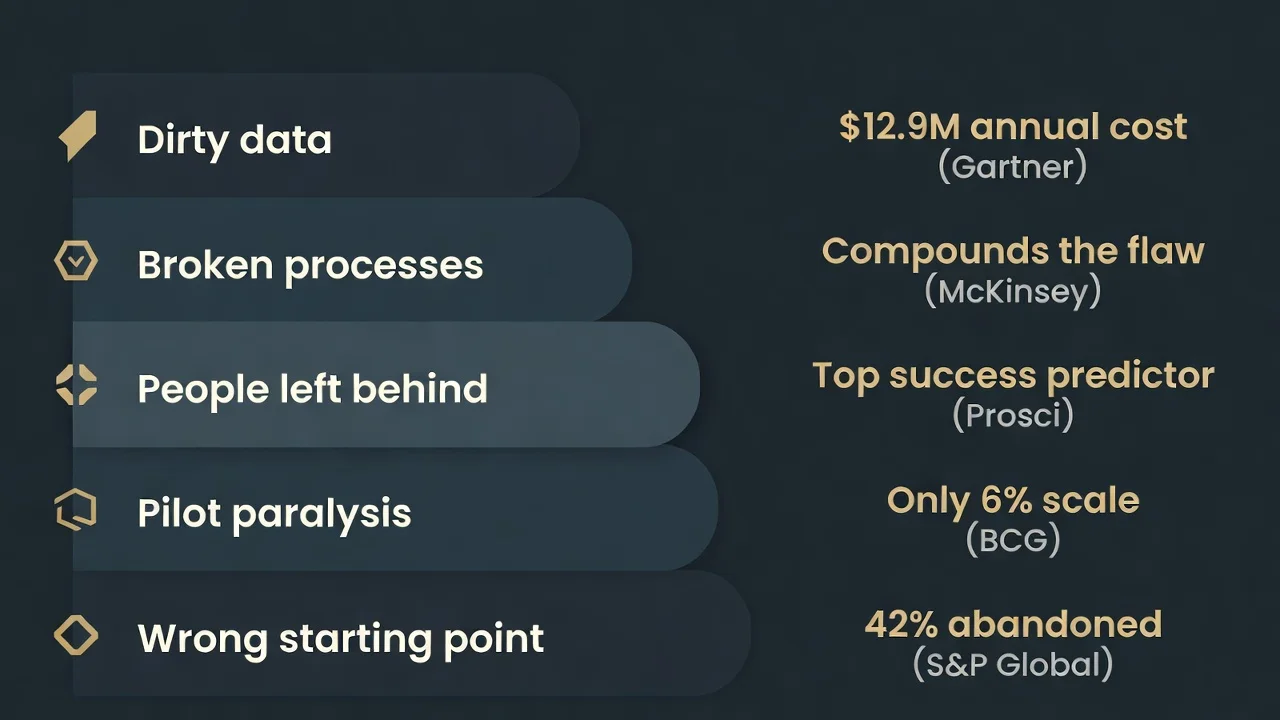
1. Dirty data
AI doesn’t fix bad data. It exposes it, then confidently delivers wrong answers at scale.
The most common failure I’ve seen in the first 60 days of an AI deployment isn’t model accuracy or integration. It’s that the data the AI is drawing from has duplicates, missing fields, inconsistent formatting, and conflicting sources of truth. Three customer records for the same person, none flagged as duplicates. Product data that says one thing in the CRM and another in the warehouse system. Five years of free-text notes in a “comments” field that nobody has read since 2021.
The research has been clear on this for a decade. Gartner has been publishing on the cost of poor data quality since the early 2010s, with their most-cited estimate putting the average annual cost to organisations at around $12.9 million. That was before AI made the problem cheaper to expose and faster to act on.
A human analyst would spot the contradictions and ask. An AI doesn’t ask. It produces an answer, formatted confidently, ready to action.
Then someone actions it.
Self-diagnostic: When was the last time anyone audited your core customer or operational data for duplicates, accuracy, and completeness? If the answer is “I don’t know” or “we don’t do that,” you have a data problem before you have an AI problem.
2. Broken processes
Automating a broken process makes it worse, faster.
This is the failure that catches the most operationally-minded leaders out, because it looks like the AI has succeeded. The tool deployed. The integration worked. Throughput went up. But three months in, error rates climbed, customer complaints rose, and the team that was meant to be freed up is now doing double the rework.
The pattern is well-documented. McKinsey’s research on operations automation has flagged for years that automating a flawed process compounds the flaws rather than fixing them. The operational version looks like this: a team automates a customer-segmentation process that everyone agrees is “broken but functional.” The automation triples the throughput. It also triples the volume of customers receiving the wrong communications. Same broken process. More of it. The technology delivered exactly what it was asked to do. That was the problem.
AI amplifies what you do well, and exposes what you do badly. If a process is broken at human scale, automating it doesn’t make it work. It just makes the failure faster and more expensive.
Self-diagnostic: Is the process you’re planning to automate one that currently works well, or one that’s been “good enough” for years because humans patch over the gaps?
Read more: the Process pillar →
3. People left behind
The technology arrives. The people don’t.
Every transformation wave I’ve worked on has had a version of this pattern, and the research confirms it. Prosci’s annual change-management benchmarking has consistently found that the single biggest predictor of transformation success is the quality and depth of people-side change management, not the technology choice. A leadership team commits to the change. Budget gets approved. Tools get bought. Training is scheduled. And then, six months in, adoption sits at 15%, the project board is asking why, and the answer is some variation of: people don’t trust it, don’t understand it, or are quietly working around it.
With AI, this is sharper than it was with CRM or digital. People know AI threatens specific jobs. They’ve read the headlines. They’ve heard the predictions. When AI tooling arrives without a clear, honest answer to “what does this mean for me,” the answer they construct for themselves is usually worse than the truth, and the resistance follows.
Capability is the other half. The leaders signing off on AI investment often haven’t used the tools they’re approving. The teams expected to operate them often haven’t been trained on what good output looks like, or how to spot when the AI is wrong. Without that, the AI’s output gets either rubber-stamped or rejected wholesale. Neither works.
Self-diagnostic: Who in your organisation can confidently tell you what the AI tool you’ve bought is good at and what it’s bad at? If the answer is “nobody” or “the vendor told us,” that’s your capability gap.
Read more: the People pillar →
4. Pilot paralysis
The pilot worked. The rollout never happened.
BCG’s 2024 research found that 74% of companies struggle to achieve and scale AI value. Only 6% qualify as true AI high-performers. Other industry research puts the proof-of-concept-to-production transition rate at 26%. Pick the number you like. They all say the same thing: most AI work gets stuck in pilot.
The pattern is depressingly consistent. The business runs a pilot, usually with a willing department head and a sympathetic vendor. The pilot produces a positive case study. The case study gets presented to the board. The board approves “scaling it.” Then nothing happens for nine months.
The reason is rarely technical. It’s that the pilot was set up in conditions that don’t generalise. A pet-project team. A clean data subset. An engaged early-adopter user group. None of which exist at scale. Scaling the pilot would require fixing the things the pilot was carefully designed to avoid, and nobody wants to deliver that news to the board that just approved the budget.
Self-diagnostic: If your AI pilot succeeded, can you name the three conditions that made it succeed, and confirm that all three exist across the rest of the business where you want to deploy?
Read more: the Strategy pillar →
5. Wrong starting point
Tools first. Foundations later. Same mistake every wave.
S&P Global’s 2025 research found that 42% of companies abandoned most of their AI initiatives in 2025, up from 17% the year before. Two and a half times the abandonment rate in twelve months. That isn’t a market correction. That’s a starting-point problem catching up with everyone at once.
The companies losing ground to AI right now aren’t the ones who ignored it. They’re the ones who bought Copilot licences, signed enterprise GenAI contracts, or stood up internal AI task forces before answering three basic questions: what’s the business outcome we want, what would have to be true for AI to deliver it, and are those things actually true in our business today?
The companies that get it right reverse the order. Outcome first. Readiness assessment second. Tool selection third. BCG’s “Build for the Future” research, which has tracked AI maturity across more than 2,700 companies, finds the same pattern: the 6% of high-performers don’t have better technology than everyone else. They have better foundations underneath it.
Self-diagnostic: Can you write down, in one sentence, the specific measurable business outcome your AI investment is meant to deliver, and the three readiness conditions that have to be true for it to work? If you can’t, you’re at the wrong starting point.
Read more: the Technology pillar → and the Governance pillar →
The same wave, three times
I’ve watched this play out before. Twice.
Wave one, the 2000s: CRM. Businesses bought Salesforce, Microsoft Dynamics, Siebel, before deciding what they wanted to do with customer data. Implementation followed purchase. Adoption followed implementation. Value followed adoption, eventually, for the ones who stuck with it. Most didn’t. Gartner reported CRM failure rates of 50-70% throughout the decade. Same pattern. Wrong starting point.
Wave two, the 2010s: digital. Data lakes before data quality. Personalisation engines before unified customer records. Analytics platforms before anyone knew what question they wanted to answer. The businesses that won the 2010s digital wave were the ones who fixed their foundations before they bought the shiny thing. The ones that lost spent ten years in pilot paralysis.
Wave three, now: AI. Copilot licences before process documentation. ChatGPT enterprise rollouts before data governance. Agentic AI experiments before anyone has audited whether the systems being agentically operated are actually fit for purpose.
The technology changes. The pattern doesn’t.
The 6% who succeed in each wave aren’t smarter or better-funded. They start with foundations. They earn the right to deploy the technology by being ready for it. They treat readiness as the prerequisite, not the afterthought.
That’s what 25 years of pattern recognition tells me. The technology gets shinier each wave. The reasons businesses fail to use it well stay exactly the same.
Where to go from here
If your AI project failed, or you’re watching one fail in slow motion, the first question isn’t what tool do we try next? It’s which of the five patterns above are we sitting in?
The AI Readiness Audit names the gap in 7 minutes. 30 questions, six pillars (Data, Process, People, Technology, Strategy, Governance), an honest score, no card, no sales call. It’s the diagnostic I built around the patterns I’ve spent 25 years watching repeat.
For people who want the full diagnosis, pillar-by-pillar commentary and prioritised next steps written against your actual answers, the £97 Full Report picks up where the free audit ends.
Frequently asked questions
What percentage of AI projects fail?
The most cited figure is 95%, from MIT’s NANDA project (2025), based on analysis of 300 AI deployments. BCG’s 2024 research adds context: 74% of companies struggle to achieve and scale AI value, and only 6% qualify as true AI high-performers. S&P Global’s 2025 research found 42% of companies abandoned most of their AI initiatives last year. The numbers vary because they measure different things, but the direction is consistent: most AI investment is not yet producing measurable value.
Why do most AI projects fail?
Five patterns repeat across sectors and company sizes, and research firms from McKinsey to BCG to Gartner have been documenting versions of them for over a decade: dirty data, broken processes being automated, people left behind by the change, pilot paralysis (succeeding in proof-of-concept but failing to scale), and starting with tools instead of foundations. Technology failure is rare. Business-readiness failure is the norm.
What is the biggest reason AI fails in small businesses?
For SMBs (20-200 employees), the most common single failure pattern is the wrong starting point: buying or trialling tools before establishing what business outcome they’re supposed to deliver, and whether the underlying data and processes can support them. Smaller businesses also tend to skip readiness assessment because they assume their scale makes it unnecessary. It doesn’t. The patterns scale down.
How can I tell if my AI project is going to fail?
Three early warning signs: nobody can name the measurable business outcome the project is meant to deliver, the pilot is running in conditions that don’t exist elsewhere in the business, or the data feeding the AI hasn’t been audited for quality in the last 12 months. Any one of these predicts trouble. All three together predict failure.
What should I do before starting another AI project?
Establish your readiness baseline before you select a tool. That means assessing your current state across the six pillars that determine whether AI can succeed in your business: data quality, process maturity, people capability, technology fit, strategic clarity, and governance. The free AI Readiness Audit covers all six in 30 questions.
Is AI failure just the same pattern as previous tech rollouts?
The patterns are nearly identical, which is the point. CRM in the 2000s, digital in the 2010s, and AI now have all produced failure rates between 70-95%, driven by the same underlying causes: wrong starting point, broken foundations, and people not brought along with the change. Gartner, McKinsey and BCG have all tracked these patterns across the previous two waves. The technology changes. The pattern doesn’t.
For the signs visible before a project fails, see seven signs your business isn’t ready for AI.
How long does it take to recover from a failed AI project?
It depends on what failed and why. Data and process foundations take 6-18 months to rebuild properly. People and capability gaps can move faster if the leadership commitment is real. The harder cost is usually internal: a failed AI project often makes the next one harder to fund, because the organisation lost confidence. Diagnosing what actually failed (rather than blaming the technology) is the fastest route to that next funding round.
Carl Chessum is the founder of AI Readiness Partner and the author of AI Readiness for Marketing Leaders, available on Amazon. He has spent 25 years inside transformation programmes, client-side and consultancy-side, across PLC, VC-backed and private-equity-backed businesses.