Seven signs your business isn't ready for AI
Most businesses overestimate how ready they are for AI. Seven signs your business isn't ready yet, across data, process, people, technology, strategy and governance.
By Carl Chessum
Most businesses overestimate how ready they are for AI.
That isn’t a guess. BCG’s 2024 research found that only 6% of companies qualify as true AI high-performers, despite the vast majority believing they have an AI strategy underway. MIT’s NANDA project found that 95% of AI projects fail to deliver measurable value. Both numbers point at the same gap: businesses are starting AI work without an honest read on whether they’re ready for it.
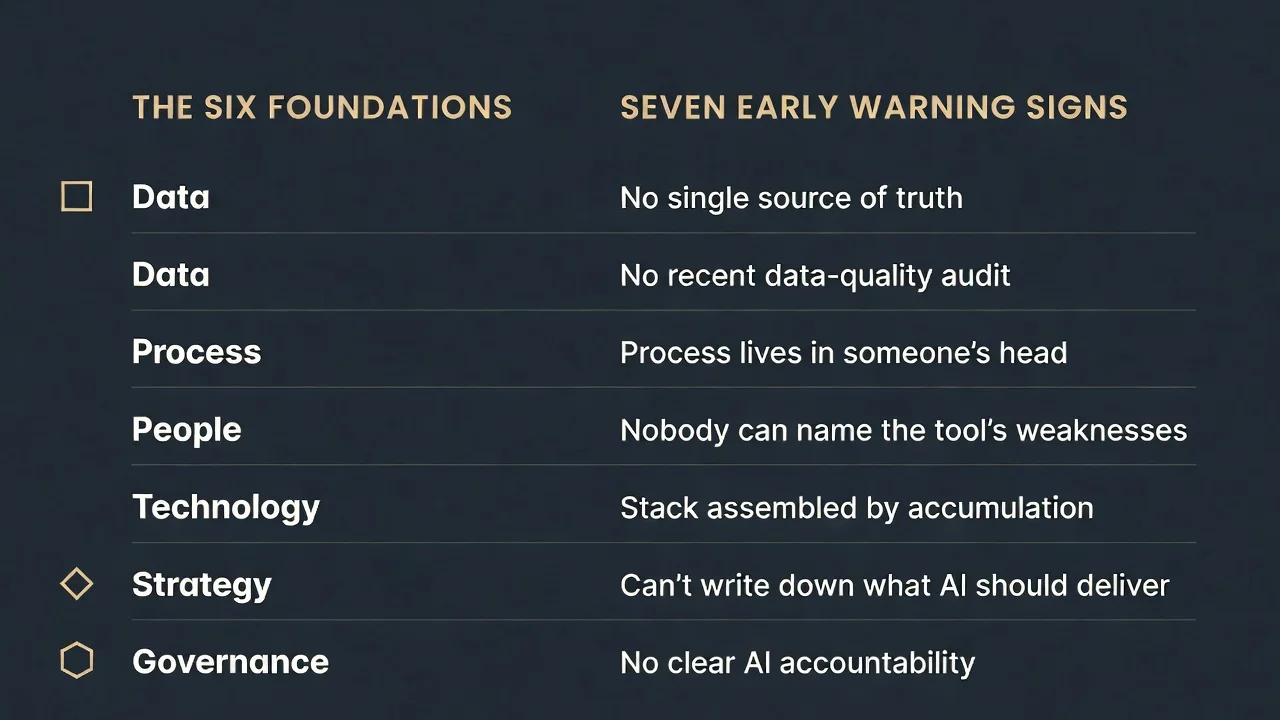
The signs that you’re not ready are usually visible months before the AI project fails. They sit across six foundations: data, process, people, technology, strategy, and governance. They’re easier to spot than the failure that follows.
I’ve spent 25 years inside transformation programmes, client-side and consultancy-side. The signs below are the ones that show up earliest, and the ones that most reliably predict that an AI investment will not return. If two or more of them feel uncomfortably familiar, your business is not ready for AI yet. Not in a permanent way. In a fixable way. But the fix has to come before the AI, not after it.
The seven signs
1. You can’t answer “where is the source of truth for our customer data?” in one sentence
Pillar: Data
If the answer involves naming three systems, or a sentence that starts with “well, it depends,” you have a data-foundation problem.
Most SMBs have customer data scattered across a CRM, an email platform, a billing system, a support ticketing tool, and at least one spreadsheet. None of them agree with each other. There’s no master record. There’s no defined hierarchy of which system wins when they conflict.
AI needs a source of truth. Without one, it picks whichever record it sees first and produces confident answers based on whichever version of reality it stumbled into. That isn’t an AI problem to be solved with a better model. It’s a foundation problem to be solved with a master data decision.
Gartner has been publishing on the cost of poor data quality for over a decade, with their most-cited figure putting the average annual cost to organisations at around $12.9 million. That cost compounds when AI starts acting on the bad data automatically.
What ready looks like: You can name the system that holds the master record for each core entity (customer, product, transaction, employee), and you have a documented rule for what happens when systems disagree.
2. Nobody has audited your data quality in the last 12 months
Pillar: Data
This is the second data sign, and it catches even businesses that do have a clear source of truth.
Data decays. Customers move. Products get renamed. Categorisation conventions drift. Free-text fields fill up with notes that contradict the structured fields next to them. If nobody has done a structured audit in the last twelve months (checking for duplicates, completeness, accuracy, and consistency), the data the AI is going to operate on is older and dirtier than you think it is.
This is the single most common failure I’ve seen in the first 60 days of an AI deployment. The leadership team is shocked at how bad the outputs are. The data team isn’t surprised at all. They knew.
What ready looks like: Someone in the business is accountable for a periodic data-quality audit. They run it on a schedule. They report findings. Someone fixes what gets flagged.
3. Your “process documentation” lives in someone’s head
Pillar: Process
If the answer to “how do we actually do X?” is “ask Sarah, she’s been here forever”, your processes aren’t documented. They’re tacit.
Tacit processes work at human scale because humans patch the gaps. They notice the edge cases. They know when to break the rule. They remember the customer who needs the workaround. None of that knowledge is written down anywhere an AI can read.
When you automate a tacit process, you automate the documented 60% and lose the undocumented 40% that actually made the process work. The output looks correct at first. Then the edge cases start surfacing, and there’s nobody catching them because the patching humans have been removed from the workflow.
McKinsey’s research on operations automation has flagged this pattern for years: automating a flawed process compounds the flaws rather than fixing them. The version I see in SMBs is sharper. Automating an undocumented process compounds the gaps that nobody knew existed, until they did.
What ready looks like: Your core operational processes (the ones AI is being considered for) are written down. Someone other than the process owner could execute them from the documentation. Edge cases are flagged, not buried.
Read more: the Process pillar →
4. Nobody in the business can tell you what the AI tool you’re buying is actually good and bad at
Pillar: People
This sign appears in almost every pre-purchase conversation I see. The leadership team is enthusiastic. The board has approved budget. The vendor has demoed. And when you ask the person who will operate the tool day-to-day what its known weaknesses are, the question gets answered by the vendor, not the buyer.
That’s a capability gap, and it predicts adoption failure better than almost any other signal.
Prosci’s annual change-management benchmarking has consistently found that the single biggest predictor of transformation success is the quality and depth of people-side change management, not the technology choice. The pattern holds at SMB scale. If the people expected to use the AI tool can’t articulate its limitations before they buy it, they won’t catch its mistakes after they deploy it.
What ready looks like: At least one person in the business, not a vendor representative, can describe what the AI tool is good at, what it’s bad at, what its known failure modes are, and how you’d detect a bad output. If nobody can answer those questions, you’re buying on faith.
Read more: the People pillar →
Pause: the audit names which of these you’re sitting in
If two or more of the signs above already feel familiar, the rest of this article will be uncomfortable reading. There’s a faster way to get the full picture.
The AI Readiness Audit scores your business across all six foundations (Data, Process, People, Technology, Strategy, Governance) in 30 questions. 7 minutes. Free. No card, no sales call. The free score tells you which foundations need work before AI is worth the investment. If you want the pillar-by-pillar diagnosis with prioritised next steps written against your actual answers, the £97 Full Report picks up where the free audit ends.
5. Your tech stack was assembled by accumulation, not design
Pillar: Technology
Most SMB tech stacks weren’t designed. They grew. A tool got bought to solve a problem in 2019. Another one got added in 2021 because the first one didn’t quite work. A free trial got upgraded to a paid plan because nobody cancelled it. The marketing team uses three tools the operations team has never heard of. The CRM has been replaced twice but the data from version one is still being referenced in reports.
This stack is what your AI is going to integrate with.
Integration is where AI projects quietly die. The vendor’s demo runs on clean APIs and tidy data flows. Your business runs on a stack where half the systems don’t talk to each other and the other half talk to each other in ways nobody fully documented. The AI tool can be excellent and still fail to deliver value because it can’t get to the data it needs in the form it needs it.
What ready looks like: You have a current architecture diagram. You know which systems are sources of truth, which are downstream consumers, and how data flows between them. You can identify, before you buy, which systems the new AI tool needs to talk to and what shape that conversation needs to take.
Read more: the Technology pillar →
6. You can’t write down, in one sentence, what AI is supposed to deliver for your business
Pillar: Strategy
This is the sign that catches the most ambitious businesses out. There’s energy. There’s appetite. There’s budget. There’s a sense that AI is important and that the business needs to “be doing something with it.” There isn’t a one-sentence answer to what specifically.
The companies that get AI right reverse this. They start with the business outcome they want (a specific measurable improvement in a specific function), and work backwards to whether AI is the right tool for it. The companies that fail start with the tool and try to retrofit the outcome.
S&P Global’s 2025 research found that 42% of companies abandoned most of their AI initiatives in 2025, up from 17% the year before. Two and a half times the abandonment rate in twelve months. That isn’t AI getting worse. It’s the strategy gap catching up with everyone at once.
What ready looks like: You can complete this sentence in writing: “By [date], AI will deliver [specific measurable outcome] in [specific business function], measured by [specific metric].” If you can’t fill those four blanks, you don’t have a strategy yet. You have an aspiration.
Read more: the Strategy pillar →
7. You don’t have a clear answer to “who’s accountable if the AI gets it wrong?”
Pillar: Governance
This is the sign that surfaces last, and the one that costs the most when it surfaces.
AI produces decisions. Decisions have consequences. When the consequences are positive, accountability rarely matters. When they’re negative (a customer is wrongly denied a service, a regulator asks why a process was operated this way, an internal investigation needs to reconstruct what happened), the question “who decided this?” becomes urgent.
Most SMBs deploying AI have no clear answer. The vendor isn’t accountable beyond the contract. The IT team didn’t make the decision. The business team trusted the AI’s output. The board approved the tool but not the specific actions it took. The result is a governance gap that only becomes visible when something goes wrong, by which point it’s too late to design the controls that would have prevented it.
This isn’t a question of building heavy enterprise governance for a small business. It’s a question of being able to answer, before AI is deployed, two things: which decisions is the AI authorised to make on its own, and which decisions require a human to review before they’re actioned.
What ready looks like: You have a written decision-rights framework for the AI tool you’re considering. You know which outputs auto-execute and which require a human-in-the-loop. You know who that human is. You have a documented escalation path when the AI’s output is questioned.
Read more: the Governance pillar →
What to do if more than two of these feel familiar
If you’re recognising two or more of the signs above, your business isn’t ready for AI yet. That isn’t a failure. It’s a useful diagnostic.
The companies I’ve seen succeed with AI didn’t start out ready. They worked out which foundations needed building, sequenced the work, and earned the right to deploy AI by being ready for it. The ones that failed skipped that step. There’s a defensible reason that BCG’s research finds only 6% of companies qualify as true AI high-performers. And it isn’t that 94% of businesses are incompetent. It’s that 94% started before they were ready.
The AI Readiness Audit names the gap in 7 minutes. 30 questions, all six foundations, an honest score. Free. No card, no sales call.
For people who want the full diagnosis, with pillar-by-pillar commentary, signs ranked by severity in your specific business, and prioritised next steps written against your actual answers, the £97 Full Report is the next step.
Frequently asked questions
How do I know if my business is ready for AI?
Readiness is measurable across six foundations: data quality, process maturity, people capability, technology fit, strategic clarity, and governance. If you can answer “where’s our source of truth,” “is our process documented,” “who’s accountable for AI decisions,” and “what specific outcome are we expecting,” with concrete answers in one sentence each, you’re closer to ready than most. If two or more of those questions don’t have clear answers, your business has foundation work to do before AI is worth the investment.
What are the most common signs a business isn’t ready for AI?
The earliest signs sit in the data and strategy foundations: no single source of truth for core data, no recent data-quality audit, and no one-sentence answer to what AI is supposed to deliver. These show up months before an AI project formally fails, and they’re the most predictive signals that the investment won’t return.
Can a small business be ready for AI without an enterprise-scale data platform?
Yes. Readiness isn’t about scale of infrastructure. It’s about clarity of foundations. A 30-person business with one well-documented CRM, written processes, and a clear definition of what AI is supposed to deliver is more ready than a 5,000-person business with seventeen unintegrated systems and an “AI strategy” that doesn’t name an outcome. The patterns scale down.
How long does it take to get a business ready for AI?
It depends on which foundations need work. Data-quality remediation is typically 6-18 months for an SMB. Process documentation is faster: weeks to a few months if leadership commits to it. Strategy and governance can be defined in days if the leadership team is willing to make decisions. The longest fix is usually data; the cheapest is usually strategy.
Should I take the AI Readiness Audit before or after I start an AI project?
Before, ideally. The audit is designed to identify the foundations that need work before they get exposed by a failing AI project. If you’ve already started a project and it’s struggling, the audit still surfaces the underlying patterns and gives you a fix-list, but the cheapest place to spot a readiness gap is before the budget is committed.
Is being “not ready” for AI permanent?
No. Every foundation in the audit is fixable. The point of identifying signs you’re not ready isn’t to discourage AI adoption. It’s to sequence the work so the AI investment actually returns. Most businesses I see are 6-18 months of focused work away from being genuinely AI-ready. The mistake is skipping that work, not the work itself.
What’s the difference between this and the “why AI projects fail” patterns?
They’re two sides of the same diagnosis. “Why AI projects fail” describes the patterns observed after a project has gone wrong. The signs above are the early warning signals visible before the project starts. Read them together: signs to spot upfront, patterns to recognise in the aftermath.
Carl Chessum is the founder of AI Readiness Partner and the author of AI Readiness for Marketing Leaders, available on Amazon. He has spent 25 years inside transformation programmes, client-side and consultancy-side, across PLC, VC-backed and private-equity-backed businesses.